
You’re missing a tooth. Not a whole row. Not your entire smile. Just one. And now you’re stuck wondering: what do I actually do about this?
It’s a fair question. A quick internet search gives you too many answers. A friend swears by her implant. Your neighbor has had a bridge for twenty years. And someone at work mentioned they just left the gap alone. So let’s break down the real options for replacing one missing tooth. No sales pitch. Just the facts, so you can have an informed conversation with Dr. Gardner.
Option One: Do Nothing
Technically, this is an option. But it’s not a good one.
When you lose a tooth, the surrounding teeth start shifting toward the gap. Your bite changes. The opposing tooth may drift downward because nothing is stopping it. And the jawbone beneath the gap begins to shrink because it no longer has a root to stimulate.
What starts as one missing tooth can become a cascade of new problems. Jaw pain. difficulty chewing. teeth that become harder to clean. Most patients who “wait and see” end up needing more extensive work down the road.
Option Two: A Traditional Dental Bridge
A bridge has been the standard solution for decades. The two teeth next to your gap get shaved down. A three-unit restoration, one replacement tooth with a crown on each side, gets cemented over those prepared teeth.
The upsides: It’s faster than an implant. Usually two or three appointments. It’s often covered by insurance. And it looks natural when done well.
The downsides: You have to permanently alter two healthy teeth. Shaving them down is irreversible. Those crowned teeth also become harder to clean at the gumline, which increases your risk of decay or gum disease down the road.
A bridge typically lasts 10 to 15 years before needing replacement. That sounds good until you realize you might replace it two or three times over your lifetime.
Option Three: A Removable Partial Denture
This is the most budget-friendly option. A single false tooth attached to a gum-colored plastic base with metal clasps that hook onto neighboring teeth.
The upsides: Lowest upfront cost. No drilling on healthy teeth. You can take it out to clean it.
The downsides: It’s removable, which means it feels removable. Many patients find them uncomfortable or embarrassing. The metal clasps can be visible when you smile. Over time, the clasps can actually wear down the teeth they attach to.
Option Four: A Single Dental Implant
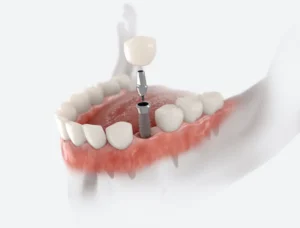
This is what Dr. Gardner recommends for most healthy patients with one missing tooth. A small titanium post gets placed in your jawbone. After several months of healing, a crown is attached on top.
The upsides: No neighboring teeth are touched. The implant fuses with your bone, which actually preserves the bone and prevents shrinkage. It feels and functions like a natural tooth. You floss and brush it normally. With good care, it can last several decades or even a lifetime.
The downsides: Longer process, usually four to eight months from start to finish. Higher upfront cost, though not always as high as people assume. You need enough healthy jawbone to support the implant.
Which One Is Right for You?
That depends on your specific situation:
- Your budget.
- Your oral health.
- How long you plan to stay in the area.
- Whether the neighboring teeth already have large fillings or crowns.
The cheapest option upfront is not always the cheapest over time. A partial that needs replacing every few years adds up. A bridge that takes down two healthy teeth may create future problems. An implant costs more now but often costs less in the long run.
Restore Your Bite Today
The best advice? Come in for a conversation. Let Dr. Gardner look at your specific gap, your bite, your bone, and your goals. Then make a decision with real information, not internet confusion.
Don’t wait for the gap to cause bigger problems. Call our Gouverneur office at (315) 203-1772 to talk through your options.